







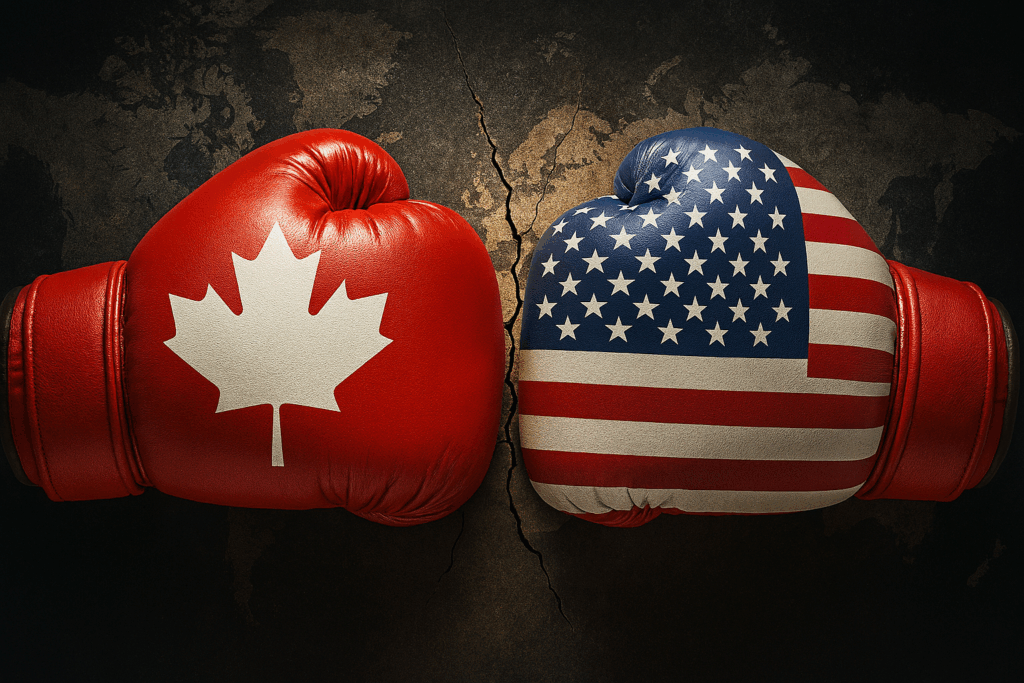
Relations between Washington and Ottawa have seen their share of chilly moments — from softwood lumber disputes to dairy tariffs — but few episodes have flared as fast or as personally as this week’s sudden rupture between the United States and Canada.
The spark? A one-minute television ad aired by the Ontario provincial government that used a 1987 speech by Ronald Reagan to criticize U.S. trade policy.
What might have passed as a minor domestic jab instead ignited a full-scale diplomatic firestorm. President Donald Trump denounced the ad as “fake” and “foreign interference,” abruptly terminated trade negotiations with Canada, and slapped an additional 10% tariff on Canadian imports. It’s the most dramatic breakdown in U.S.–Canadian relations since the height of the 2018–19 tariff war — and it’s unfolding against a fragile global economy that can ill afford more uncertainty.
The Ad That Started It All
The Ontario government’s ad, titled “Trade Fairness for All”, repurposed a portion of Reagan’s 1987 speech at the Berlin Wall — specifically his famous line, “Tear down this wall” — recontextualizing it to call for tearing down trade barriers instead. The message: tariffs hurt workers and consumers on both sides of the border.
But the edit, while clever, was controversial. U.S. commentators and Reagan-era officials accused the ad agency of “selective editing” and misrepresentation of Reagan’s words. The Reagan Presidential Foundation quickly distanced itself, saying the clip was “used without permission and distorted in meaning.”
Within hours, Trump seized on the issue during a rally in Michigan.
“Canada is running fake Reagan ads to interfere in our trade talks,” he told the crowd. “We don’t need lectures from foreign governments — especially not from one that’s been taking advantage of us for decades.”
The next morning, Trump announced on Truth Social that trade negotiations with Canada were “TERMINATED.” Later that day, the White House confirmed a new round of 10% tariffs on Canadian steel, aluminum, and auto parts — industries vital to Ontario’s economy.
A Familiar Playbook
For those who’ve followed Trump’s trade policy, the escalation followed a familiar pattern: confrontation, crisis, and leverage.
Trump’s critics call it “economic brinkmanship.” His supporters call it “the art of the deal.”
This year alone, Trump has repeatedly turned to tariffs as both punishment and persuasion. In March, he imposed sweeping levies on European vehicles after a dispute over agricultural subsidies. Over the summer, he threatened 25% tariffs on Mexico unless it tightened border enforcement.
In that sense, the Ontario controversy arrived as a convenient opening — a trigger that allowed the administration to reassert its tough-on-trade credentials.
“Trump views every trade disagreement as a negotiation, not a relationship,” said Sarah McNally, a senior analyst at the Peterson Institute for International Economics. “He doesn’t separate symbolism from strategy. If a foreign government publicly embarrasses him — even unintentionally — it becomes fair game for retaliation.”
The Canadian Response: Shock and Caution
In Ottawa, the reaction was a mix of disbelief and restraint.
Prime Minister Justin Trudeau condemned the tariffs as “unjustified and harmful,” but stopped short of escalating immediately. He urged calm, saying Canada was seeking “clarity, not confrontation.” Behind the scenes, however, trade officials scrambled to assess economic fallout and potential retaliation options.
Ontario Premier Doug Ford — whose government produced the ad — struck a more defiant tone.
“We were standing up for Ontario workers,” Ford told reporters in Toronto. “If that upsets President Trump, so be it. But we won’t apologize for defending our industries.”
Still, by midweek, reports surfaced that Ontario might pause or pull the ad campaign in an effort to cool tensions. Federal officials in Ottawa privately urged Ford’s team to “de-escalate.”
A Relationship on the Rocks
While the Reagan ad was the spark, the tinder had been piling up for months.
In early 2025, the two countries were already locked in a tariff and tech-tax standoff. Ottawa’s plan to introduce a digital services tax targeting large U.S. tech firms angered Washington, which saw it as discriminatory. The Trump administration froze trade talks in protest, calling the proposal “a direct attack on American innovation.”
Then came renewed U.S. tariffs on Canadian steel and aluminum, justified under the same “national security” provision Trump used in his first term. Canada retaliated with 25% duties on U.S. goods worth roughly $30 billion. The cycle of escalation was briefly paused this summer when both sides agreed to restart talks — the very negotiations now “terminated.”
“The trust deficit has been growing all year,” said Janice Gross Stein, director of the Munk School of Global Affairs at the University of Toronto. “The Reagan ad didn’t cause the breakdown — it was the match that lit an already leaking gas line.”
Trump’s Anger: More Than Optics
Why such fury from Washington over a provincial ad? Analysts say the reasons are partly psychological, partly political, and partly tactical.
1. Symbolic interference: Trump views the ad not as local advocacy but as a foreign provocation, especially because it used an American president’s image. In his framing, that crosses a red line — a foreign entity shaping U.S. domestic perception.
2. Personal politics: The timing coincided with Trump’s renewed campaign push to position himself as the defender of “American jobs.” Responding forcefully to perceived disrespect reinforces that image.
3. Negotiation leverage: Terminating talks and hiking tariffs create bargaining power — Trump’s signature tactic. “He escalates to reset the board,” notes trade expert Robert Wolfe of Queen’s University. “It’s how he reasserts control.”
4. Domestic theater: Trump’s base responds positively to visible strength. Picking fights with traditional allies may look reckless abroad, but it plays well in swing states where manufacturing jobs are still central to his message.
Economic Consequences on Both Sides
The impact of the tariff hike is already rippling through key industries. Canada remains one of America’s largest trading partners — more than $900 billion in goods and services cross the border each year.
A 10% increase on Canadian imports means higher costs for U.S. automakers, construction firms, and consumers. Economists warn it could also trigger retaliatory tariffs, higher prices for goods like cars and appliances, and potential supply chain slowdowns ahead of the holiday season.
“Tariffs don’t exist in a vacuum,” said economist Avery Shenfeld of CIBC World Markets. “They’re taxes on both sides of the border. And in tightly integrated industries like autos, nobody wins.”
Financial markets reacted cautiously. The Canadian dollar dipped 0.7% against the U.S. dollar after Trump’s announcement. Steel and aluminum stocks slid on both sides of the border.
Ottawa, meanwhile, is weighing legal action under the USMCA — the trade pact that replaced NAFTA — arguing that the tariffs violate the deal’s provisions on fair treatment.
The Diplomatic Fallout
Beyond economics, the episode has chilled political cooperation in other areas. U.S.–Canada coordination on defense, energy, and environmental policy has quietly stalled. Meetings planned for late October between senior ministers have been postponed indefinitely.
Canadian officials also worry the rift could spill into continental energy talks, especially concerning new cross-border pipelines and electric-vehicle supply chains — key sectors for both economies.
“The political temperature is now dangerously high,” warned Colin Robertson, a former Canadian diplomat. “It’s not just about steel or an ad — it’s about trust. And right now, there’s very little of it left.”
Where Things Go From Here
So far, neither side appears eager to back down completely. Trump has hinted that the tariffs could be “reviewed” if Canada “shows respect.” Ontario is reportedly considering editing or withdrawing the Reagan ad to remove U.S. imagery, though no official decision has been made.
Trade experts predict a temporary cooling-off period before negotiations resume under quieter conditions. But the damage — both political and economic — may linger long after the ad fades from TV screens.
“This episode will be studied for years,” said McNally. “It shows how fragile alliances can become when politics, personality, and policy collide.”
The Bottom Line
A one-minute ad, a 10% tariff hike, and a storm of angry posts have pushed two of the world’s closest allies to the brink of a trade freeze.
For Trump, it’s another example of wielding tariffs as weapons — using outrage to maintain leverage and project dominance. For Canada, it’s a painful reminder that in an age of volatile politics, even symbolic gestures can carry real-world consequences.
The U.S.–Canada partnership has weathered centuries of disputes, but this one — born from a single advertisement — underscores how quickly the smallest spark can ignite a diplomatic wildfire.
Sources
- Trump Announces Trade Negotiations With Canada ‘TERMINATED’ Over Ontario Reagan Ad — Time LINK
- Trump ends trade talks with Canada over ‘fake’ Reagan ad — Politico LINK
- Trump raises tariffs on Canada by 10% in retaliation for anti-tariff TV ad — The Guardian LINK
- Trump to raise Canada tariffs by 10% — Supply Chain Dive LINK
- Trump ends trade talks with Canada over tariffs ad — AP News LINK
- Ontario premier provokes Trump’s ire once again with Reagan ad — Reuters LINK
- Trump announces additional 10 percent Canada tariff over Reagan ad — Al Jazeera LINK
- Trump Announces Canada Tariff Increase over Reagan Ad ‘Fraud’ — Newsweek LINK
- Trump Says He Will Raise Tariffs on Canada by 10% Over Ontario Ad — Wall Street Journal LINK
- Trump Says He’s Increasing Canada Tariffs by 10% After Ontario Ad — Bloomberg LINK